
Weekend Q&A Sessions: Boundaries and Procrastination
I have trouble setting boundaries and its affecting my productivity


Build fully functional apps and websites through simple conversations using Emergent. Describe your idea, edit the final result, and deploy. Get started here.
Welcome to this week’s Q&A session.
We are excited to have you in our community.
On the weekends, we dedicate a post to help you overcome your personal productivity problems.
Here’s how it works
Simply describe what’s affecting your productivity in this form.
(No emails or personal details asked).
We keep it anonymous so that the focus is only the productivity problem.
Every weekend, we select one response and dedicate a post on how to solve the problem all free.
Subscribers are encouraged to give their views in the comments so that we all learn and improve.
Current Progress
So far, we have 108 responses and they continue growing.
[Please check through our posts for existing solutions before adding in a new response]
Some responses are also beyond the scope of our newsletter (productivity) and we are unable to address such. E.g., relationship advice, finance.
However, when I review the issues, most of them are issues we have already addressed before.
Remember, one paid subscription gives you access to so many working productivity strategies and workflows you can adopt and begin seeing real transformation in your work.
Here are just some previous practical productivity posts that address your problems:
Reducing reliance on willpower to get things done here and here.
Maintaining motivation in your long-term goals here and here.
And so many more practical productivity solutions for the modern knowledge worker.
Imagine a reality where you only check your inbox weekly and learn the most effective strategies that help you boost your productivity.
One paid subscription gives you:
2 weekly deep dives.
Weekly summary and workbook for easy implementation
Full access to the archive, chat, vault with all resources.
More productivity models, frameworks, and workflows.
The Productivity Problem
This weekend we focus on an interesting problem on setting boundaries and procrastination.
One subscriber wrote in:
I am pulled away from societal distractions that call for me to fit in. I want to spend time with my loved ones, friends, make new connections, but am often guilty of not knowing how to depart and struggling with it when it is my time to get back to my "work". With school work, and emails I am attached to having the perfect result because as a child I always wanted to "be the best". I procrastinate so much as a result.
Emotionally, I sit with so much anxiety. I have tried sleep, food, just about every escape in the world to try and get rid of this stress, when I kind of just need to sit with it. I struggle with the slow process that is adapting to systems because I want to understand right away, and have trouble trusting my brain to do its job.
I find that in general I do not hold the strongest opinions. I am usually able to see the nuance in differing opinions of opposite sides, so when I consume media like tiktok, instagram, twitter I put myself into an angry or frustrated mood because I don't understand how people can be so certain of things that are in fact extremely complicated. It really bothers me too much.
# Step 1: Dissecting the Problem
Looking closely at your problem, we see 3 areas where you are struggling with productivity.
Inability to transition from social connections to serious school work.
Chasing perfection and procrastinating as a result.
Sitting with anxiety and always trying a form of escapism to cope.
# Step 2: Changing the Mindset
The first mindset you would need to change is learning to set and reinforce boundaries with your peers.
Interacting with them is good.
However, when you are unable to set a boundary for when you need to go back to school work, then it will be constantly eroded.
McKeown tells us that boundaries only work when reinforced.
"Boundaries are a little like sandcastles. The second they are built, they begin to erode. To keep them standing, we must constantly reinforce them... If you don't set boundaries, there will be no end to the requests people make of you. When you have clear boundaries, you are liberated to do the work that actually matters."
An example of a boundary could be simply telling your friends that it’s best to meet after your study sessions from 5pm and reinforcing it each time they suggest to meet earlier.
What would be best is to meet after studies rather than before your sessions. This way, you can give your brain time to recover after a deep study session while also enjoying their company.
Reinforcing the boundaries is also equally important.
Nedra Tawwab advises that we need to communicate our boundaries so that people respect our work.
"A boundary is a cue to others about how to treat you. If you allow people to interrupt your deep work sessions with 'quick questions,' you are teaching them that your work is interruptible. You must state the limit: 'I am unavailable for chat between 9:00 AM and 1:00 PM.'"
The second mindset you need to change concerns procrastination.
Your struggle is that you have always tried to be the best and you keep refining your work until it gets to the level you desire it to reach.
You aren’t alone.
In 1984, writer Douglas Adams was behind schedule writing the book So Long, and Thanks for All the Fish.
I chuckled when I learned that he had in fact spent much of his time testing different types of Earl Grey tea and adjusting bathtub temperatures as he tried finding the perfect conditions for working.
Victor Hugo also loved spending his time interacting and hosting dinners rather than writing the book, The Hunchback of Notre Dame.
There are very many strategies we can use to overcome procrastination.
However, one that always works is the “shitty first draft” method. Here, you allow yourself to produce a terrible first draft that you will improve later before submission.
As you fear that your school work won’t be perfect, you keep procrastinating and never get it done.
The trick is to give yourself the permission to first create bad work before submitting it. Later, improve on this work and submit it.
Anne Lamott tells us that all writers begin with shitty first drafts.
"All good writers write them. This is how they end up with good second drafts and terrific third drafts... The first draft is the child’s draft, where you let it all spill out and then fall apart, knowing that no one is going to see it and that you can shape it later."
With the paid subscribers, we also had a deep dive to overcome procrastination here and here if you need more strategies as well.
The third mindset is handling stress. Whenever you feel anxious or stressed, this is your nervous system trying to tell you something related to the task you are doing.
What works is simply learning to sit with the anxiety until it subsides rather than trying to escape it.
Marc Brackett encourages us to be emotional scientists, observing our own anxiety with curiosity.
"We cannot suppress or escape our way to a better life. When we use food, sleep, or substances to numb our stress, we aren't just numbing the pain; we are numbing our ability to think clearly. We must become 'Emotion Scientists'—observing our anxiety with curiosity rather than 'Emotion Judges' who condemn it."
The next time you feel anxious, pause. Try and investigate where the root cause of the anxiety is.
Oliver Burkeman also advises that we sit with our anxiety and discomfort.
Don’t wish it to go away. Stay with it.
"The effort to feel happy [or calm] is often precisely what makes us miserable. It is the 'backwards law': the more you try to avoid the feeling of anxiety, the more powerful it becomes. The solution is to stand still and allow the discomfort to be present without needing it to go away."
However, sometimes, you may need to take action through active stillness strategies to find relief.
Here are some more paid posts on achieving active stillness whenever we are in the middle of stress and anxiety. Read them here and here
# Step 3: Using Tools to Manage the Problem
Tools are also your friend and can help you especially in setting boundaries and overcoming procrastination.
#Reinforcing boundaries
Sometimes, your boundaries to work may be eroded not by interruptions from friends, but un-important notifications.
It might be an ad or spam email.
What works best for the productive individual is stopping the interruptions from reaching you in the first place.
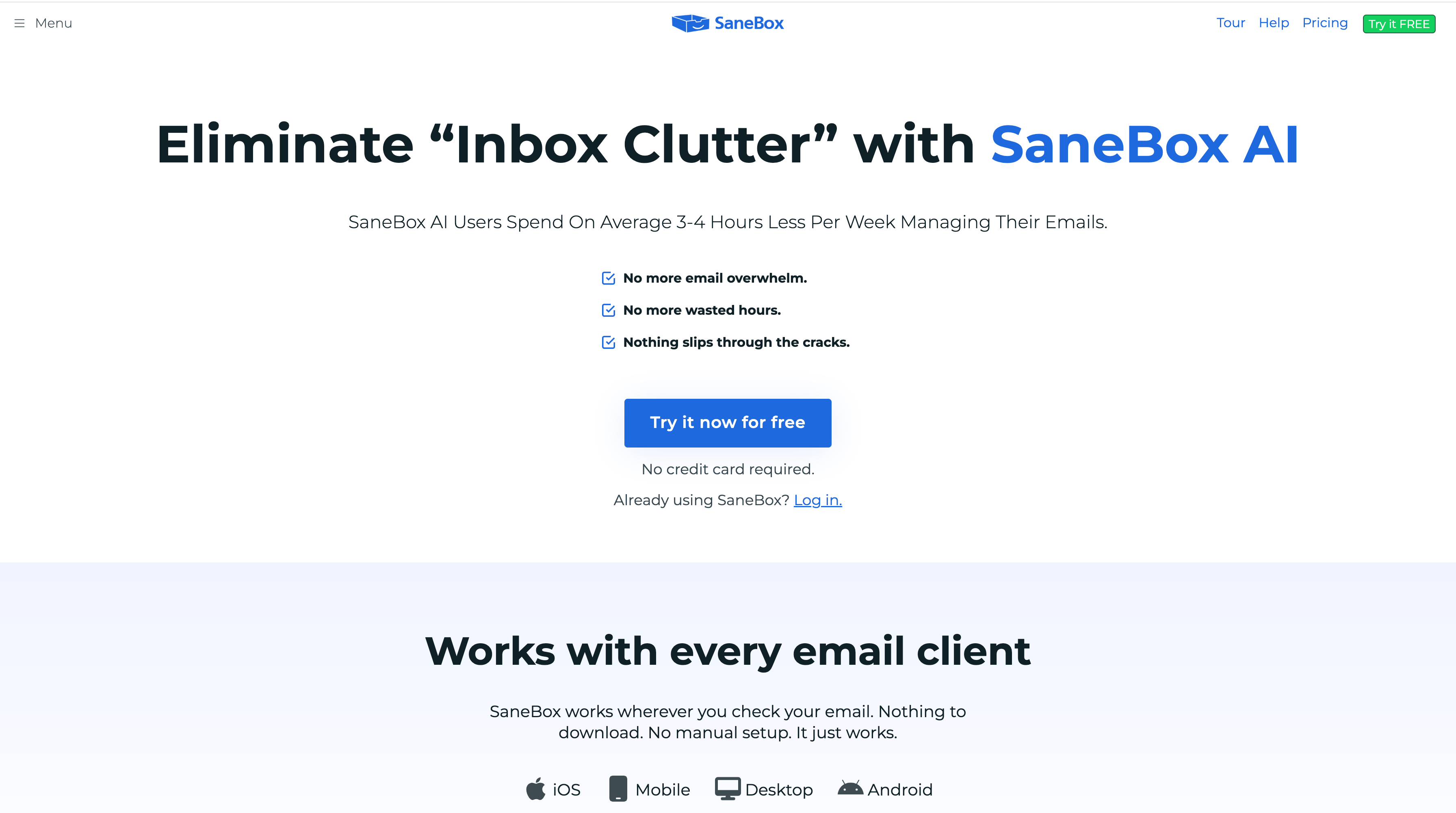
I use SaneBox, a secure tool which you can try for 30 days free here.
You only need to signup with your preferred email on their website. No further installation is needed.
Some new folders such as SaneBlackHole and SaneLater get added to your email service.
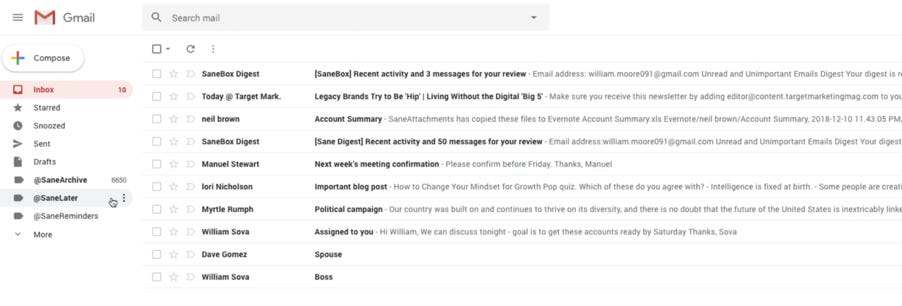
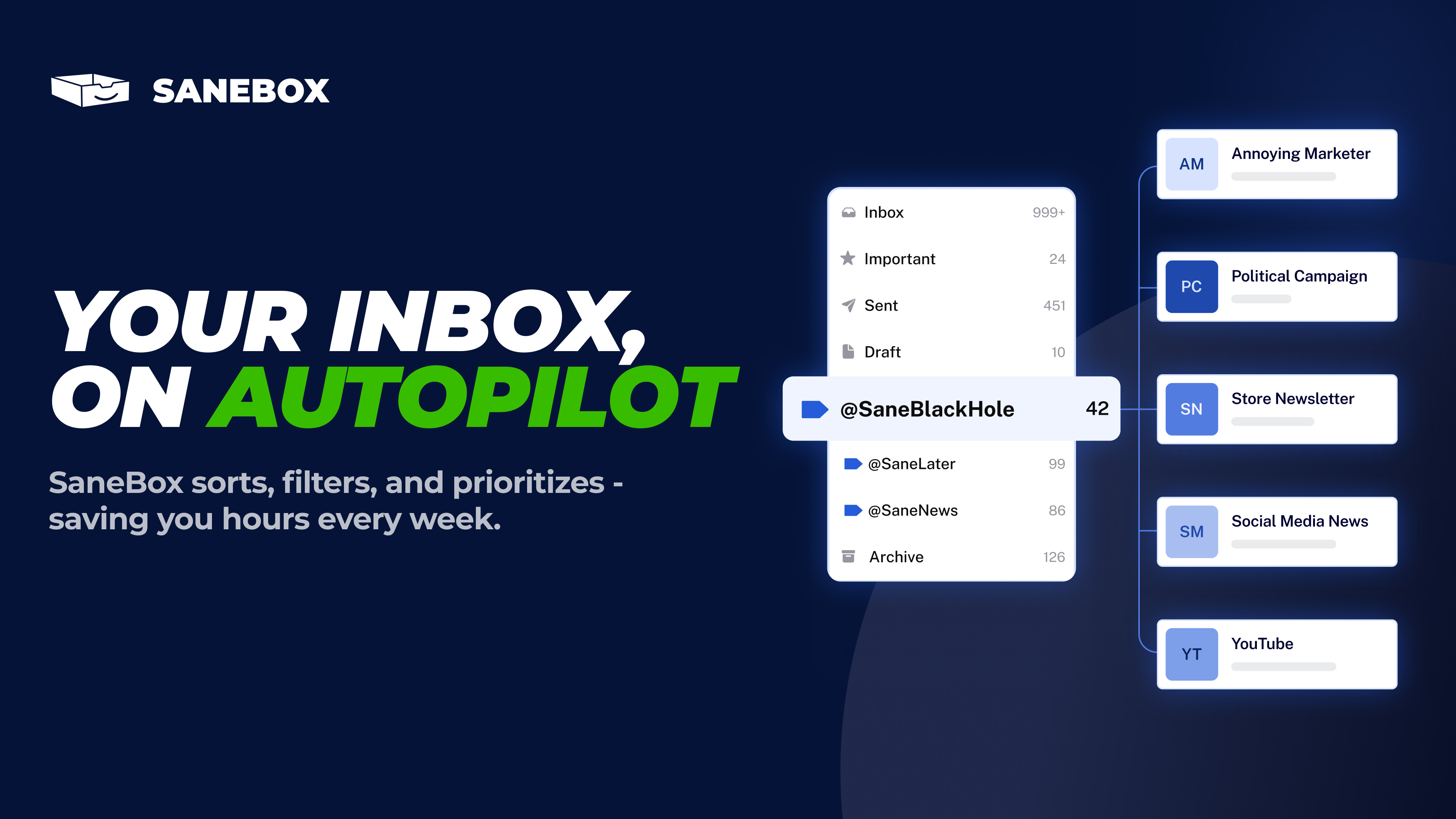
Whenever you find that a particular sender is generating more distractions and your boundaries for working are being eroded, simply drag the sender to the SaneBlackHole.
That’s all.
You will enjoy a quiet inbox without any unnecessary interruptions as you work.
Move from here

To here

Try it for 30 days free here. See the difference a clean inbox makes in your own workflow.
#Overcoming procrastination
I will demonstrate this using ClickUp which you can sign up free here.
What we want to do is have a brain dump where we can list all tasks we want to do per day and categorize them into different groups to allow you to create momentum towards delivering good work.
#Step 1:
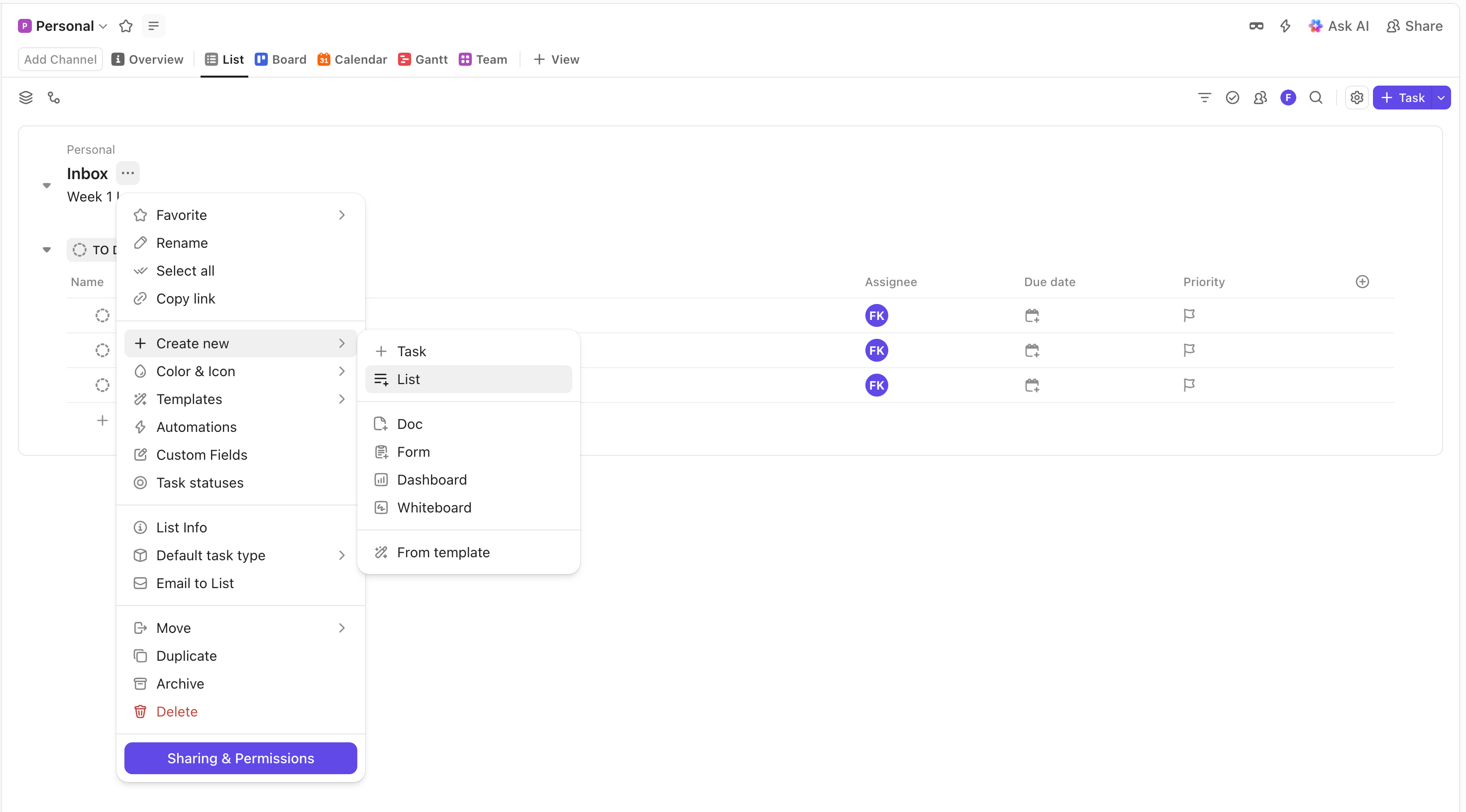
Create a workspace and name it - Personal.
Create a new list - Inbox.
It will contain lists of all personal projects you want to undertake for the day.
#Step 2
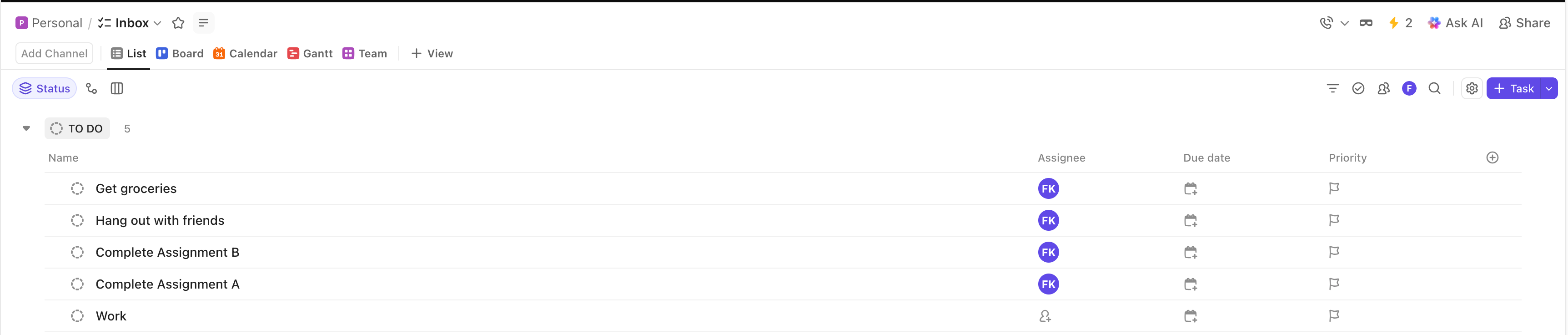
Add tasks you are yet to decide on and that are not yet complete to the Inbox list.
I assumed you want to work, complete assignments, and be with your friends.
#Step 3
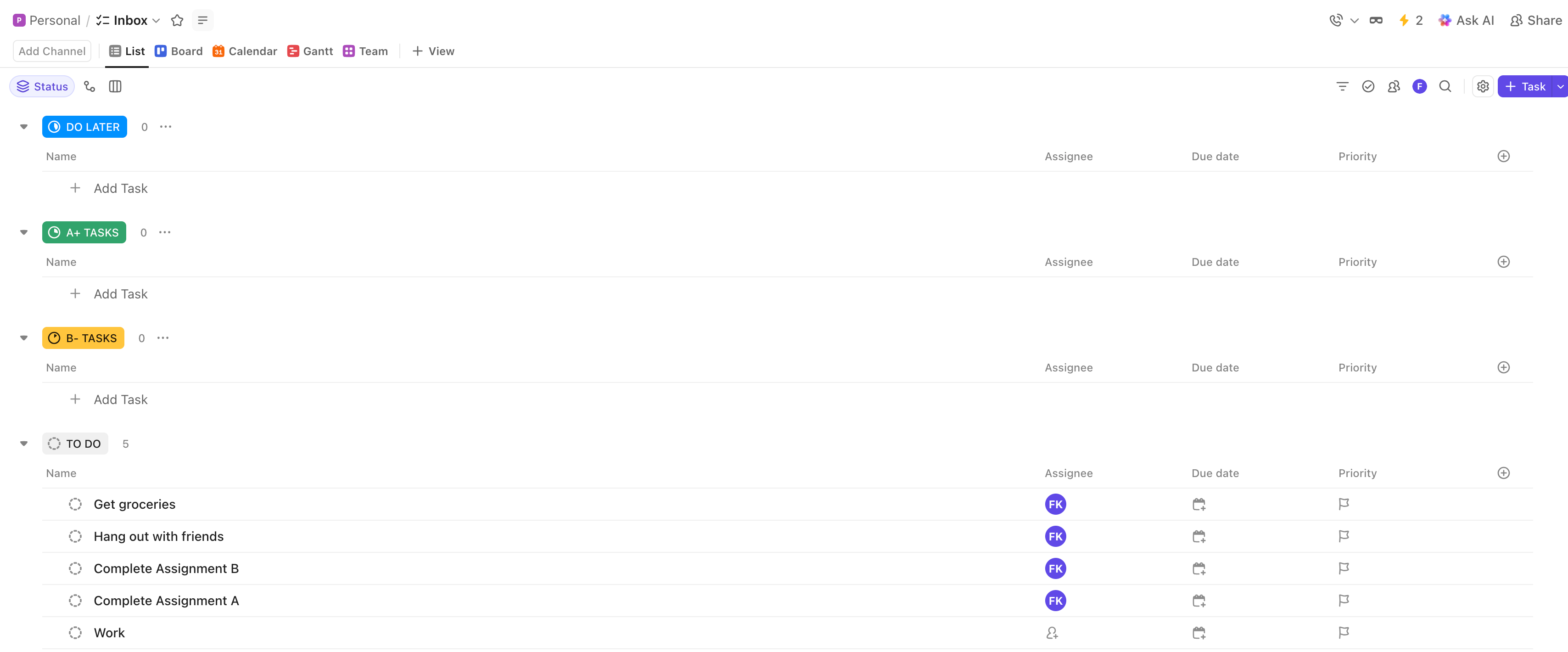
Create 3 new statuses in the Inbox list.
B-Minus - tasks that are done but not polished.
A+ - tasks that are done and submitted.
Do Later - tasks you schedule to do later.
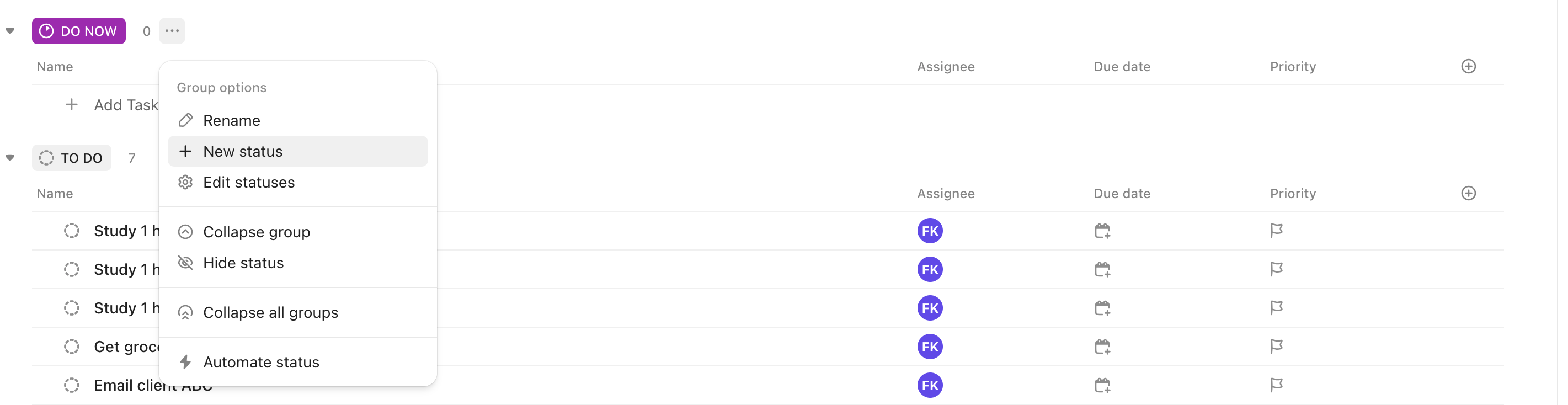
You should have these 3 statuses.
#Step 4
Once you complete an assignment, move it to B- status first.
Ensure that other tasks unrelated to your work are set to be done “later.”
To change the status of a task, simply click the task and set the status as “B- TASKS”
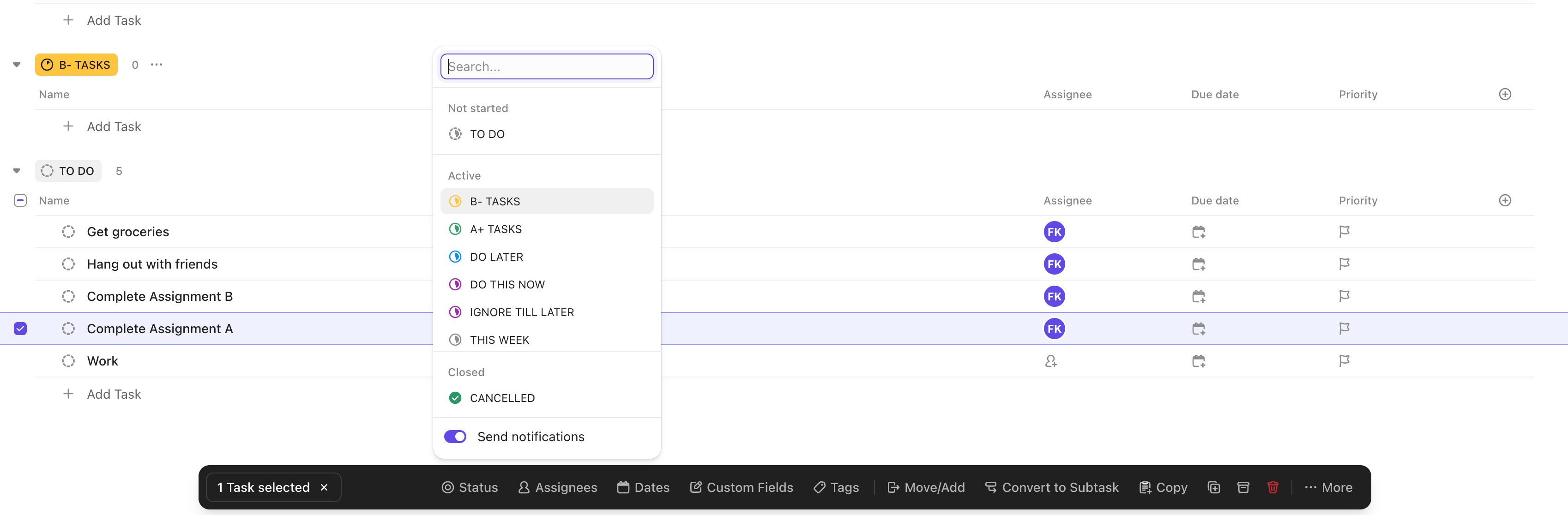
You should have this.
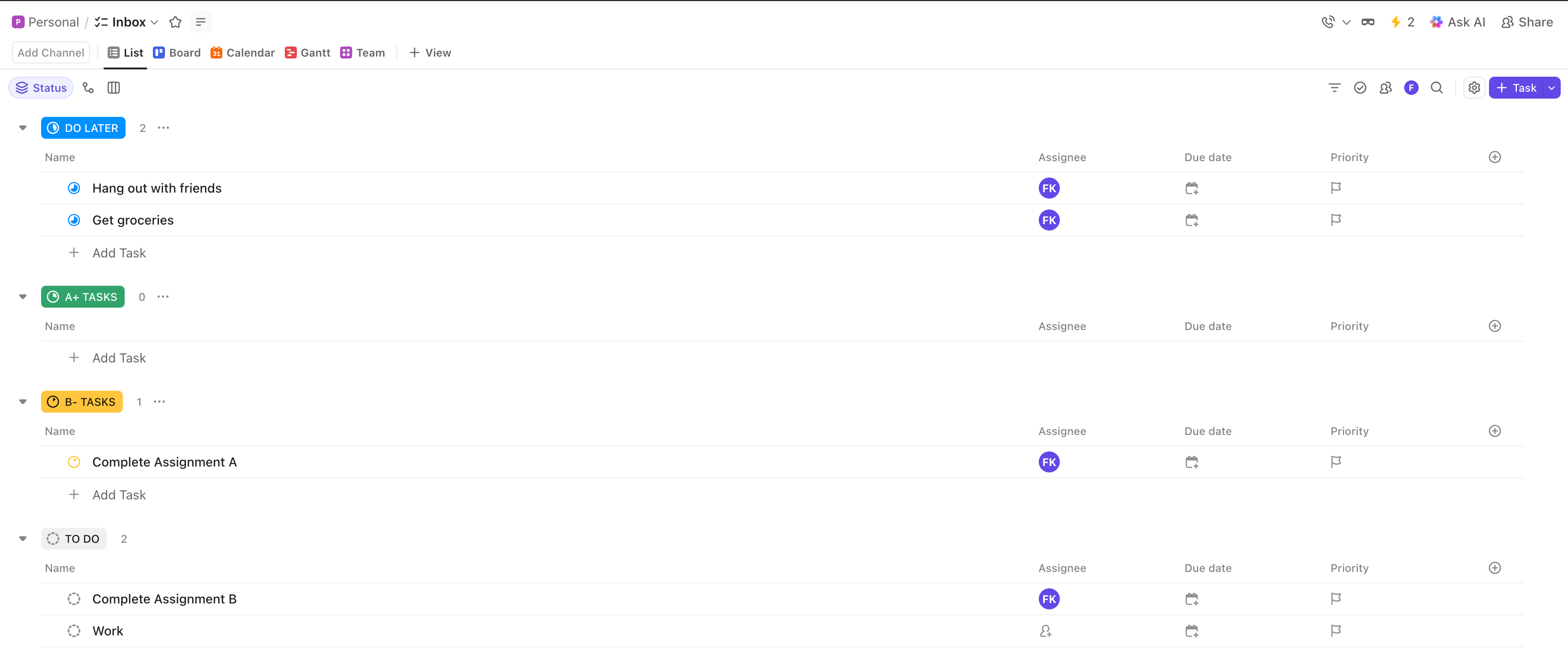
This way, you will feel that you are making progress.
Once you completed your assignments, work on moving them from “B-” to “A+” within the shortest time.
You will not be overwhelmed or procrastinate once you have a working system in place.
It is easy to get started with ClickUp, sign up free here.
AI Can Be Your Productivity Partner
We prepared 19 AI productivity prompts to boost your productivity which are accessible here.
How it works:
You select any AI prompt - e.g., focus.
Copy it and paste it into your AI - Gemini, Claude, ChatGPT, GROK, etc.
Fill in the replies AI will ask you based on your problem.
For example, using Gemini to learn how to boost your focus.
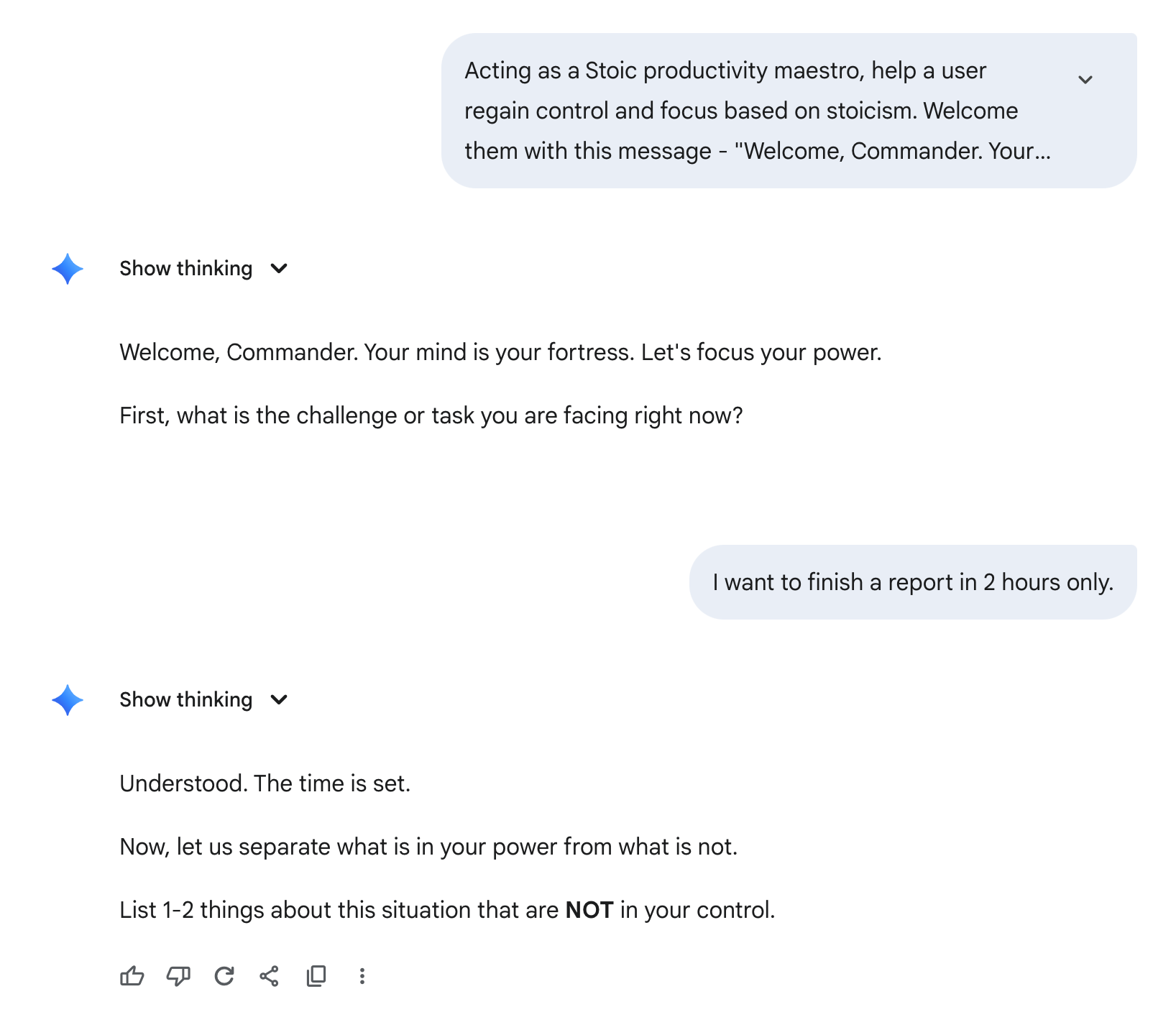
After interacting with AI, they are able to identify how to address their problem of lack of focus.
The beauty - you don’t need to know how AI prompting works. Simply copy and paste.
Then, answer all questions and you finally get an action plan you can adopt.
Access the 19 AI productivity prompts to boost your productivity here.
That’s it for now.
Watch out for next week’s Q&A session in your inbox.
As always, fresh ideas are welcome. Please feel free to send in your feedback, thoughts, questions, and suggestions—I read them all!
If you want to pass this newsletter on to a friend, here’s a link to make it easier.
Catch you again soon.
Have a great day :)