


Focus, meditate, sleep, and even relax better using Brain.fm. Test it for 14 30 days free here. No payment asked.
Back in the 1700s, cloth manufacturers were dealing with a persistent bottleneck.
If you wanted to weave a piece of cloth, no wider than 30 inches, you needed two weavers who sat on opposite sides and spun the yarn into cloth.
For the manufacturers, this meant that scalability was severely affected.
Richard Guest, in A Compendious History of the Cotton Manufacture, would write that manufacturers who had yarn and orders were constrained in finding “pairs of weavers willing or able to work in close proximity for the 14 hours required.”
John Kay saw this and came up with the Flying Shuttle, a hand-loom that could be used by only one weaver pulling a single peg.
Suddenly, weavers doubled their productivity, and had to spend time walking around the countryside begging for yarn.
However, as the innovation only improved weaving speed, it left out a critical part; the production of yarn.
Here we had weavers who could turn yarn into cloth twice as fast while hand-spinners could only produce one thread at a time. It meant that you needed 10-15 spinners to match the weaver using the Flying Shuttle.
James Hargreaves saw this and came up with the Spinning Jenny, capable of spinning up-to 80 threads at once.
The market now shifted. More yarn was being produced than the weavers with hand-looms could turn into cloth.
The human bottleneck was the constraint yet again.
The weaver, using the Flying Shuttle, was the brain of the machine and still had to manually coordinate the production of cloth from yarn.
Biological constraints such as fatigue would set in and hinder further production.
Manufacturers needed a way out and found it through Edmund Cartwright, a clergyman, who introduced the power loom.
Now, a machine could automatically weave cloth, keeping up with the pace of the Spinning Jenny. What’s more, the machine was powered by a steam engine or water wheel and programmed to produce consistent cloth quality.
Over time, more improvements such as stop-motions were added to enable human workers correct the machines when thread broke.
Weaving now became a job that even the low-skilled workers could undertake. Harriet Robinson, a former mill worker would write.
"The young girl who had been used to the slow and laborious process of the hand-loom... found herself standing before two, or even four, of these tireless monsters, watching their every movement. She was no longer a creator of cloth; she was a watcher of threads."
Overcoming Human Constraints
If we look at the historical evolution of the loom, we find a consistent pattern.Each time human cognition hit a ceiling, new innovation was introduced to break it.
It started with the mechanical hand-loom that had to be operated by two weavers. The Flying Shuttle solved it and ensured only one weaver used a hand-loom.
Then it progressed to the hand-spinners who could only spin one thread. The Spinning Jenny solved this.
The constraint moved back again to the weavers who were constrained by biology in producing more cloth from the available yarn.
The Power Loom came to break the ceiling and the hand weavers migrated upstream to be “watchers of threads.”
All through, technology was the “agent” that acted on behalf of the human and they never had to begin from zero every morning.
For the weaver, they simply turned on the Power Loom and watched the threads as they inspected the quality of the cloth.
For the spinners, they simply used the Spinning Jenny’s to scale their production without beginning from zero every time.
Why AI Agents Aren’t a Trend
Today, if we strip away AI agents to their first principles, we find that they exactly do what the Power Loom and Spinning Jenny did for the weavers and spinners.
Rather than view agents as a trend, we need to consider them as tools we delegate tasks to in order to regain our cognition.
Initially, I experimented with AI Super Agents in ClickUp which would summarize my work schedules, important meetings and tasks every morning. They indeed work in helping me migrate upwards in my daily strategy.
For example, in ClickUp I chat the agent and it helps me in scheduling or adjusting meetings.
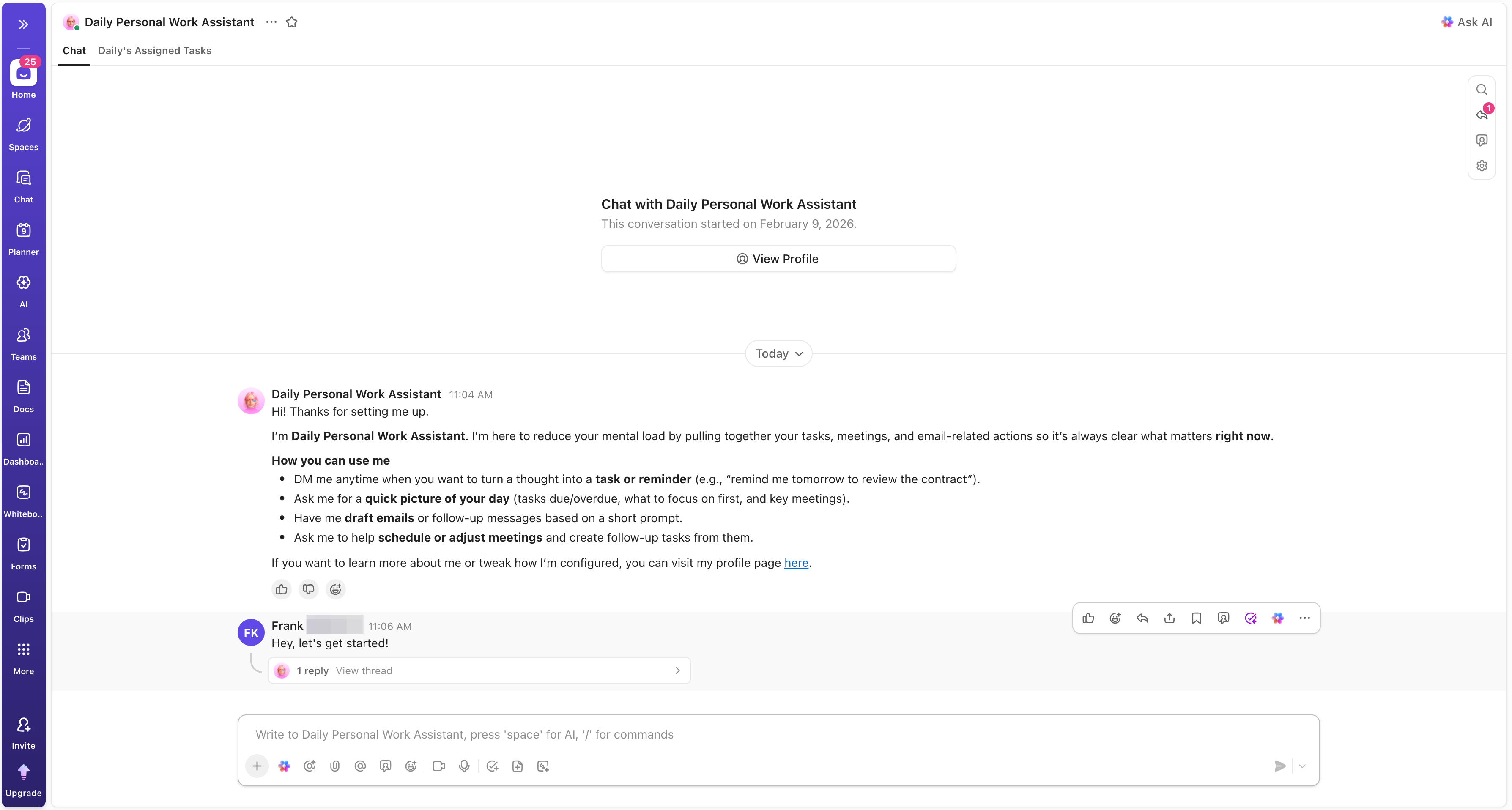
A more advanced AI agent I have also been experimenting with is the HyperAgent.
Unlike simpler agents that summarize your schedule, HyperAgents allow you to build rich outputs including podcast-style audio, webpages, and slides, including chaining together multiple tools.
Let’s consider an example.
I want to build an SaaS (Software as a Service) product. However, rather than doing the manual hard work of comparing competitors, I create an agent that does this for me.
I become a “watcher of threads” and no longer have to keep beginning from zero with the particular project.
#Step 1
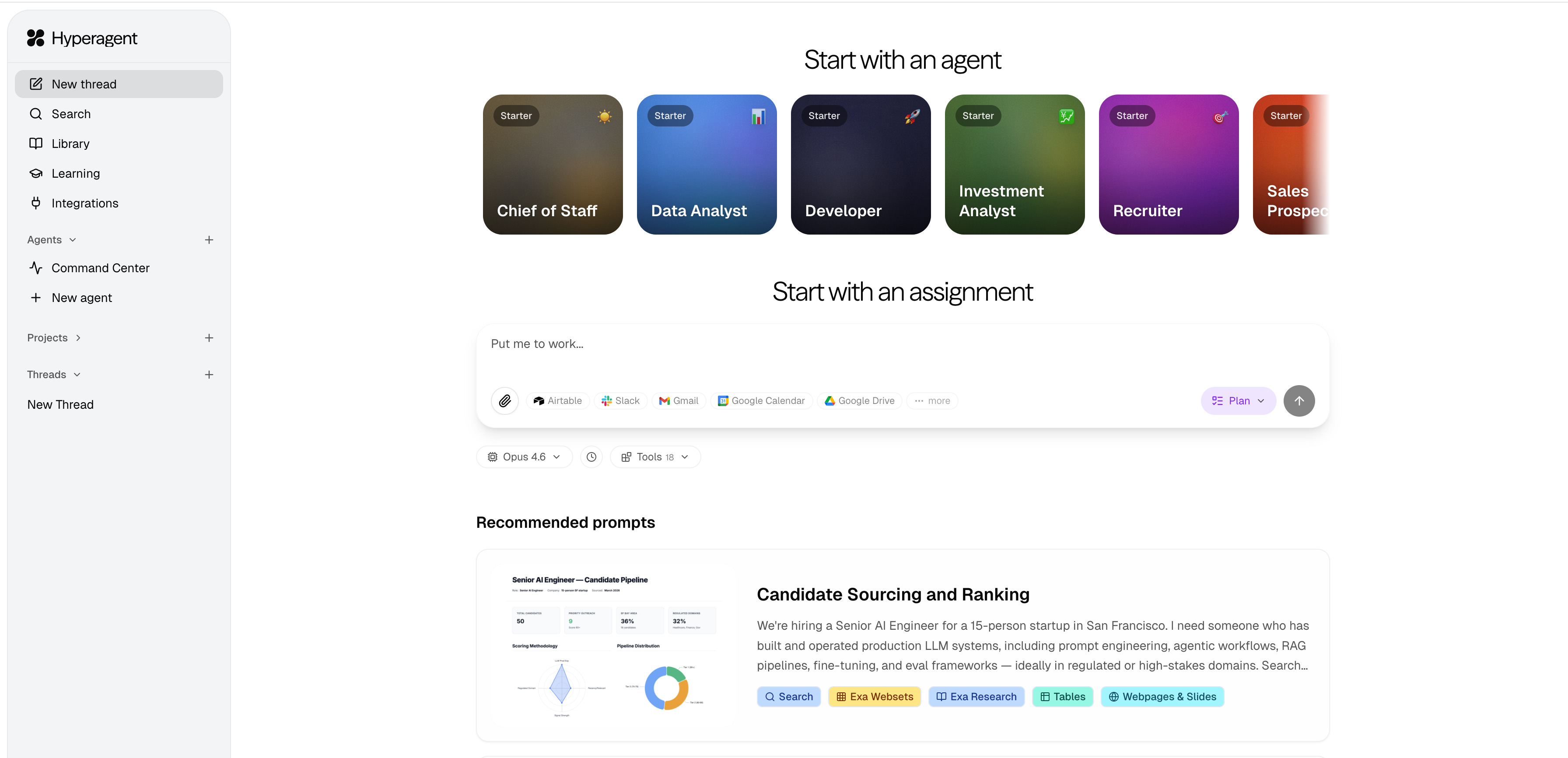
I login to HyperAgent, I see this interface.
#Step 2
I prepare the prompt for the agent I want.
Research the competitive landscape for the SaaS productivity market. Find every key player, pull their pricing pages, feature lists, funding history, and what real users are saying on Twitter and Reddit. Build me an interactive comparison webpage with a feature matrix, pricing chart, radar chart of each player’s strengths, and a detailed breakdown page per competitor with pros, cons, and real user quotes.
#Step 3
The agent proceeds to work.
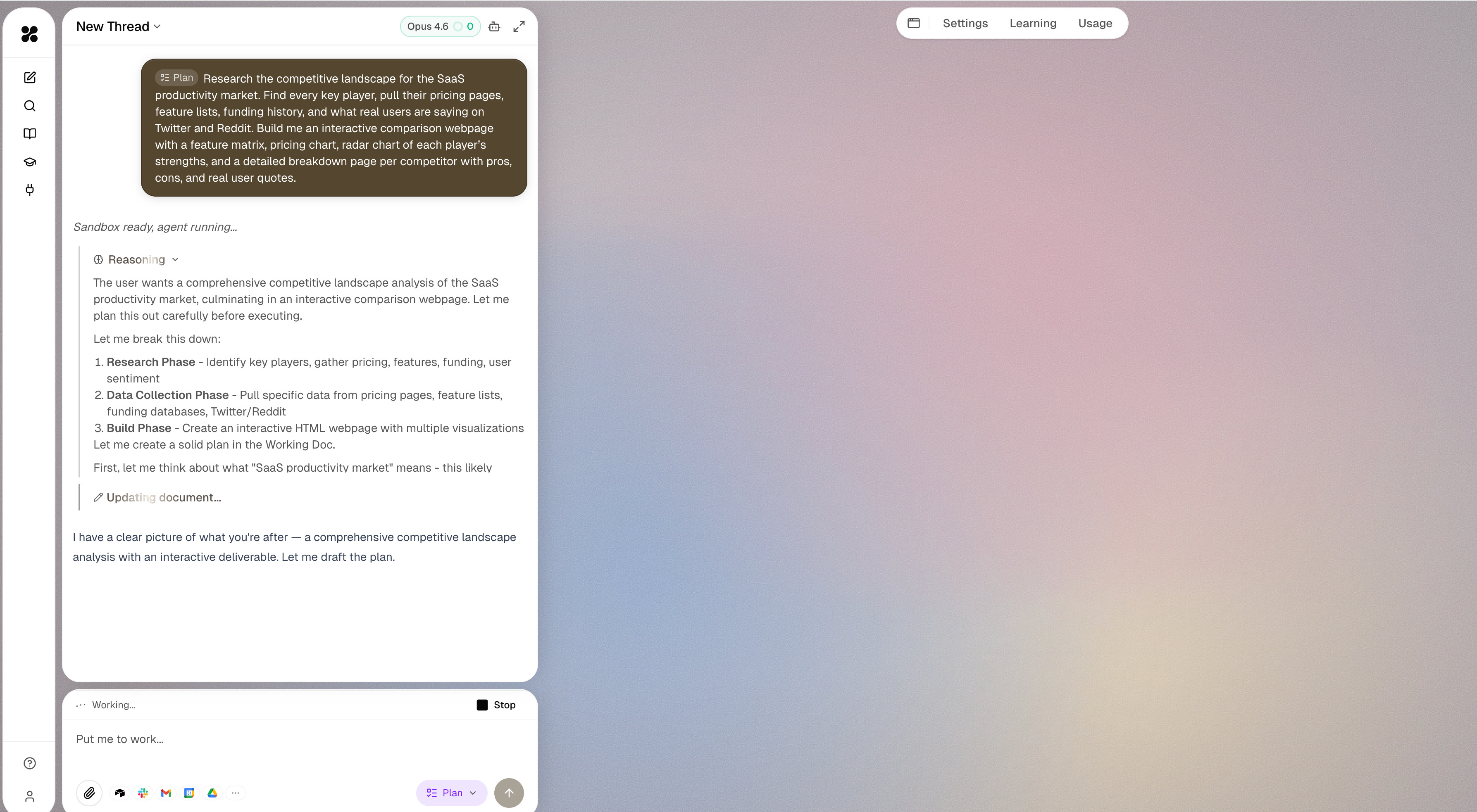
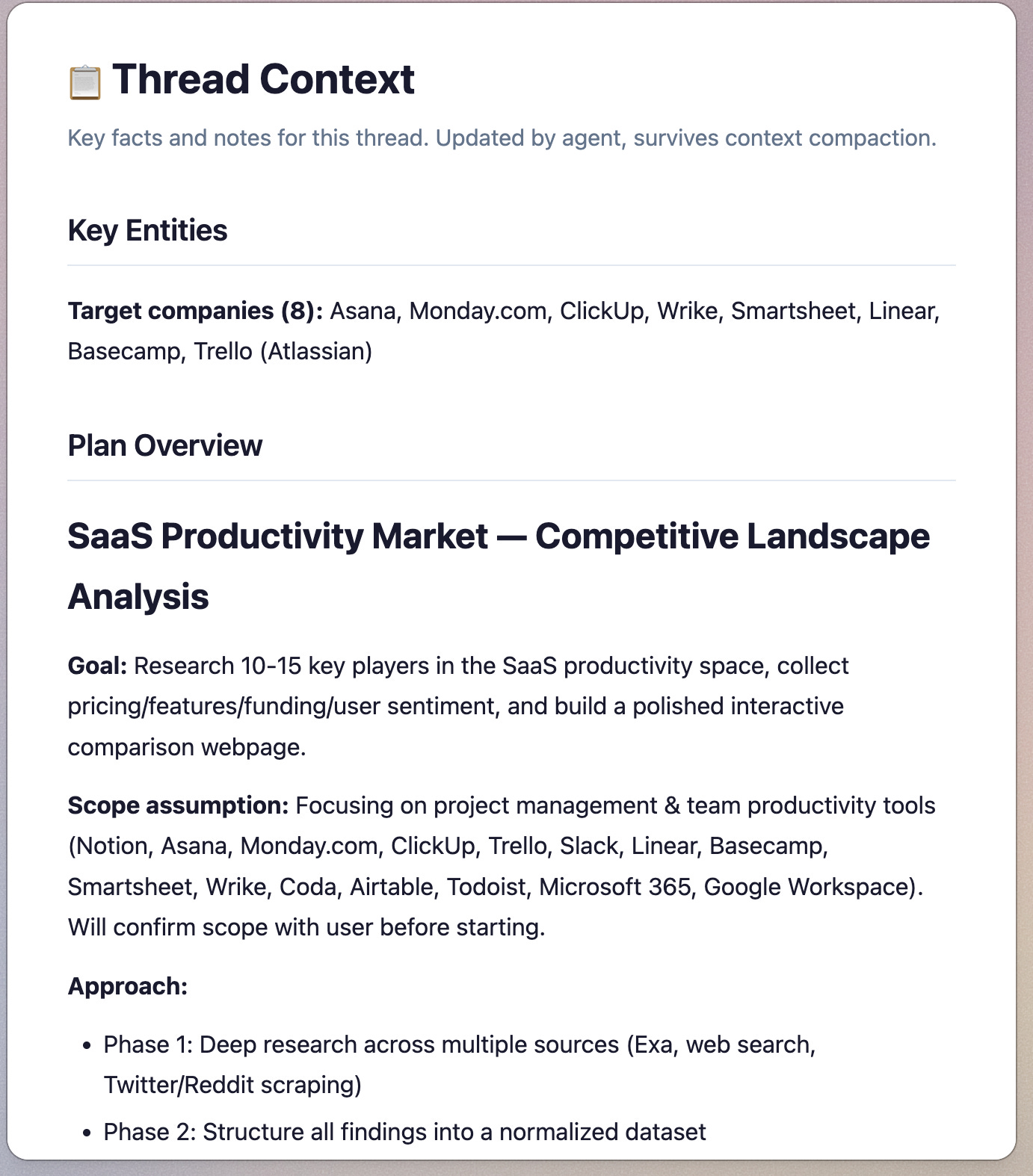
It details the plan that it is following.
#Step 4
The beauty is that it will put the results all together in a publishable webpage.
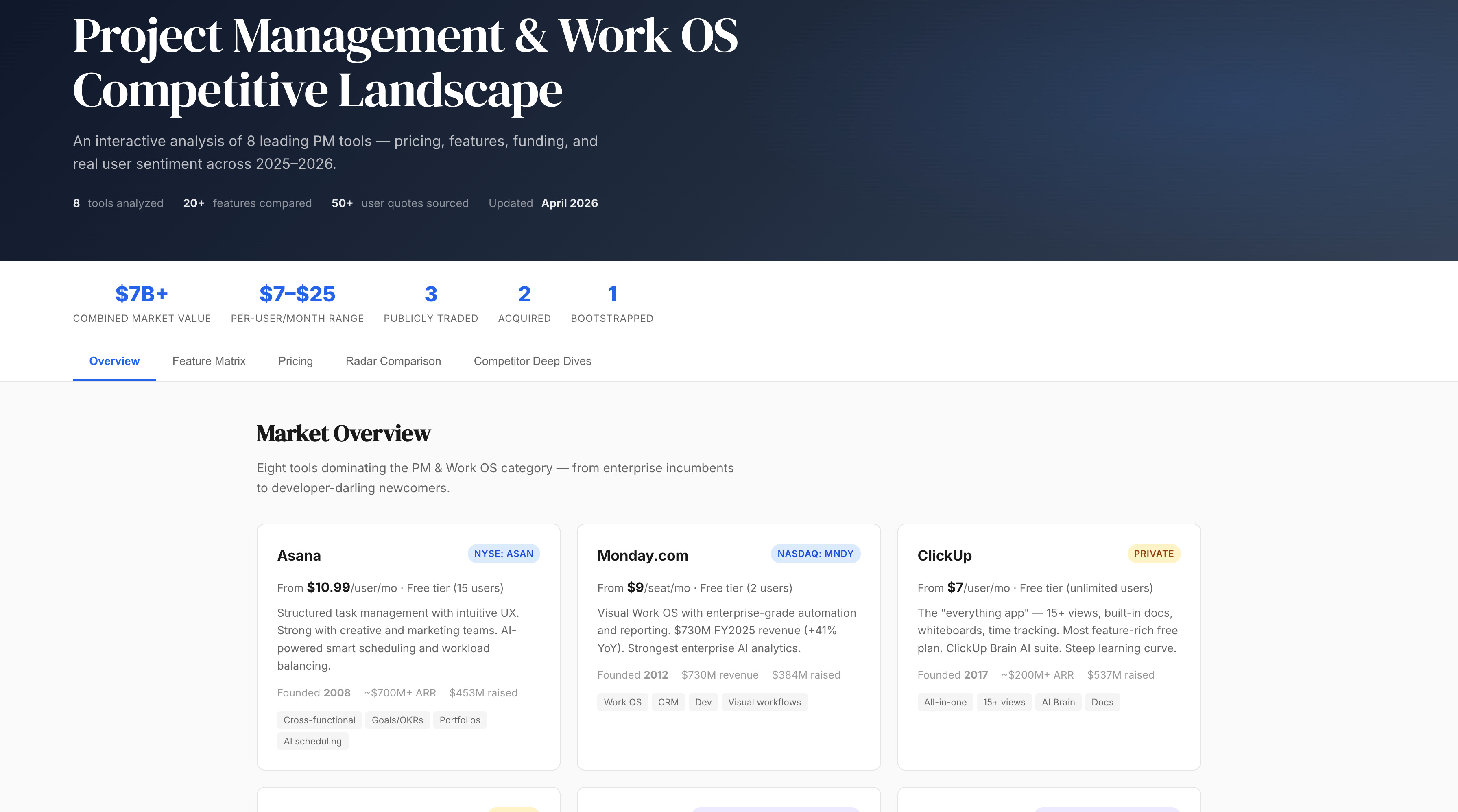
The website gives me all details I need to improve decision-making without necessarily doing the difficult menial work of scrapping hundreds of websites.
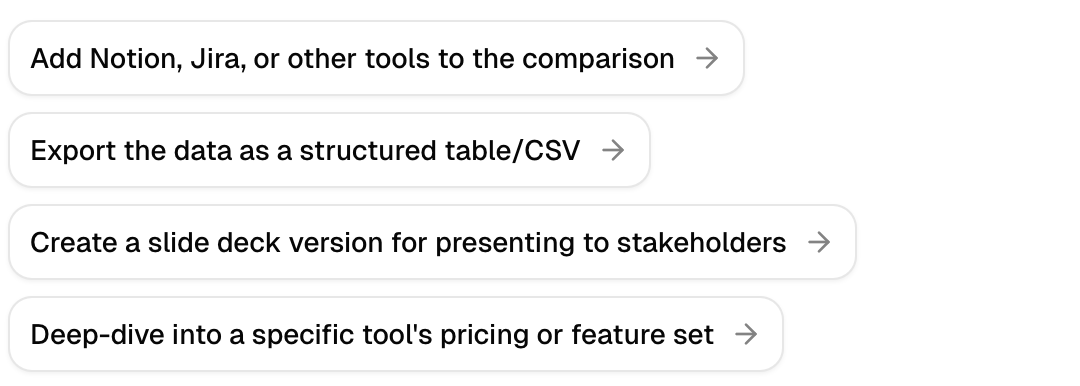
You can also export the results to excel or create a slide deck if meeting investors.
Here are $1000 credits you can use to get started with a HyperAgent in your work.
Try to see where agents can help you break your cognitive ceiling so that you can focus on strategy and avoid beginning from zero every time.
Try it before publishing your book.
Experiment before creating a new product.
That’s it for now.
Watch out for next week’s productivity insights in your inbox.
As always, fresh ideas are welcome. Please feel free to send in your feedback, thoughts, questions, and suggestions—I read them all!
If you want to pass this newsletter on to a friend, here’s a link to make it easier.
Catch you again soon.
Have a great day :)