


How do you prepare for a crucial performance?
What exactly goes through your mind when everything is at stake in your next performance?
For Tiger Woods, the September 2018 Tour Championship at East Lake Golf Club in Atlanta, Georgia was that ‘one’ crucial performance.
He had been going through a championship drought.
It had been 1,876 days (5 years) since his first win of any kind since the 2013 WGC-Bridgestone Invitational. In that period, he faced multiple health setbacks, including a spinal fusion procedure in 2017. By the end of that year, Woods was ranked 1,199th in the world.
His performance at the Tour Championship in 2018 would be the one moment that would determine whether he made a comeback as champion.
But then how did he prepare for it?
It was a paradox of sorts.
Journalist Kerr-Dineen documented the Hero World Challenge on 29 November 2018, two months after East Lake minute by minute later that same year and noticed how he followed a gradual progression.
Putting → chips/bunker → pitches → 3-wood → driver → back to wedge → driver → back to chipping → putting.
He eventually walked to the first tee and hit his opening shot.
This was peculiar because for most professional golfers, the driver gets more focus.
Golf Digest analyzed 256,064 tracked range shots from 228 PGA Tour players across events including the Masters, the Players and the US Open.
The finding was that pros spend about 10% of range sessions on driver, and more than 55% on wedges and short-to-mid irons inside 190 yards.
Tiger instead was following this approach:
1-handed putts → wedges → 8-irons → driver.
He only used the driver (used for maximum distance) at the very end of the warm-up session.
Before we brush this off as a one-off occurrence, we need to switch back 10 years earlier in 2008 at the Beijing Olympics.
Michael Phelps was attempting to win 8 gold medals in a single Olympics event, trying to break the 1972 record by Mark Spitz where he had won 7 in Munich.
Each race was crucial to breaking this record.
Yet, before each race, Phelps adopted a peculiar preparation sequence. He didn’t start by sprinting as he was expected to do during the race.
Instead, he started with 800m mixed swimming, 600m kicking, 400m pulling, 200m drills, and finally followed by short sprints at race pace.
“Once I get to the competition, it's like I'm in a cage. I know exactly what to do.” Phelps would say.
Neither Tiger nor Phelps treated focus as a light switch. They didn't demand peak, high-intensity performance from a cold start. They engineered a ramp.
The Lie of the “Binary” Brain
This week, we look at Tiger and Phelps, elite athletes in their unique sports.
What struck me was that before crucial performances, neither treated focus as a binary state.
They didn’t go from:
Distracted → Deep Work
They had a progression. They gradually moved themselves toward the state their performance demanded.
For the rest of us, this might look something like:
Scattered → oriented → engaged → specific → absorbed.
This is easy to forget when we’re sitting at a desk. We open a blank document, look at the difficult thing we need to do, and expect our minds to immediately produce their best work.
Perhaps that’s the equivalent of asking Tiger to walk onto the first tee and hit his driver without warming up.
I’ve started experimenting with a small cognitive warm-up of my own.
Before a demanding block of work, I put on Brain.fm, close the things unrelated to what I’m doing, and spend the first few minutes simply getting oriented.
I ask myself:
What am I working on?
Where did I leave off?
What is the next question?
What would a bad answer look like?
None of those is the work. They’re the wedges.
The only thing I hold constant across them is what’s in my ears. I start a Brain.fm track before the first question, and it’s usually still going by the time I’ve stopped noticing it.
It isn’t what makes me focus (the questions do that), but how I know where I am in the sequence.
By the time I get to the writing, it isn’t a cold start.
I don’t expect those first few minutes to produce my best thinking. They’re there to get me into the work.
The music has gradually become part of that transition; a small, repeatable cue that tells me I’m moving from everything else into this particular thing.
Then I begin.
Tiger doesn’t begin with his driver. Phelps doesn’t begin with a sprint.
Why should we begin our work by demanding our deepest thinking?
If you want to experiment with this yourself, Brain.fm currently offers a 7-14 days trial.
I’ve arranged a longer one-month trial (30 days) for our subscribers here:
You can simply use it as part of your own warm-up and see whether it changes the way you enter your work.
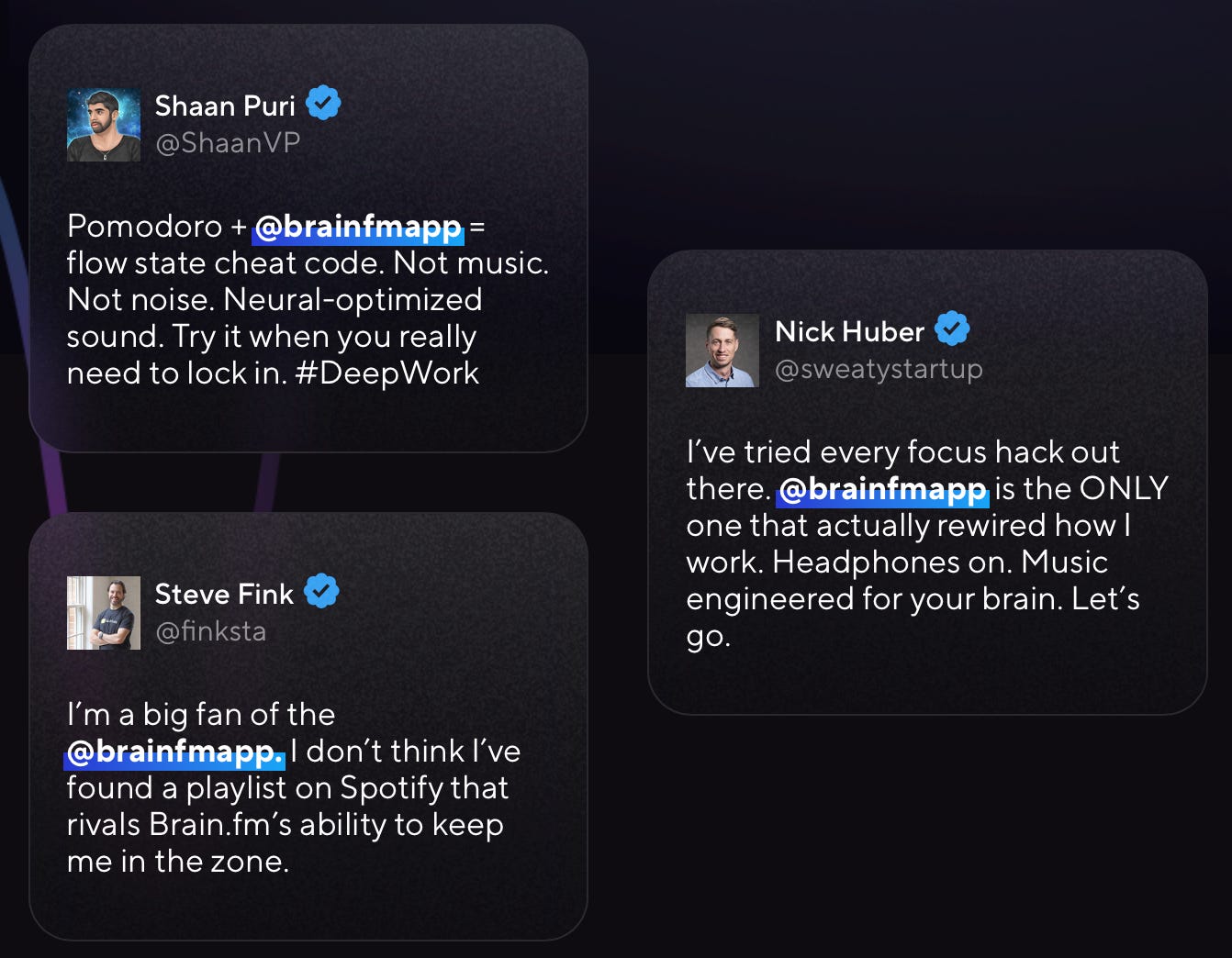
Notice the difference in your workflow just like others.
If you enjoy Monday’s posts, then the paid tier is just for you.
Rather than collecting occasional productivity articles, build a cognitive momentum system directed to help you improve your performance as a knowledge worker.
That’s it for now.
Watch out for next week’s productivity insights in your inbox.
As always, fresh ideas are welcome. Please feel free to send in your feedback, thoughts, questions, and suggestions—I read them all!
If you want to pass this newsletter on to a friend, here’s a link to make it easier.
Catch you again soon.
Have a great day :)